
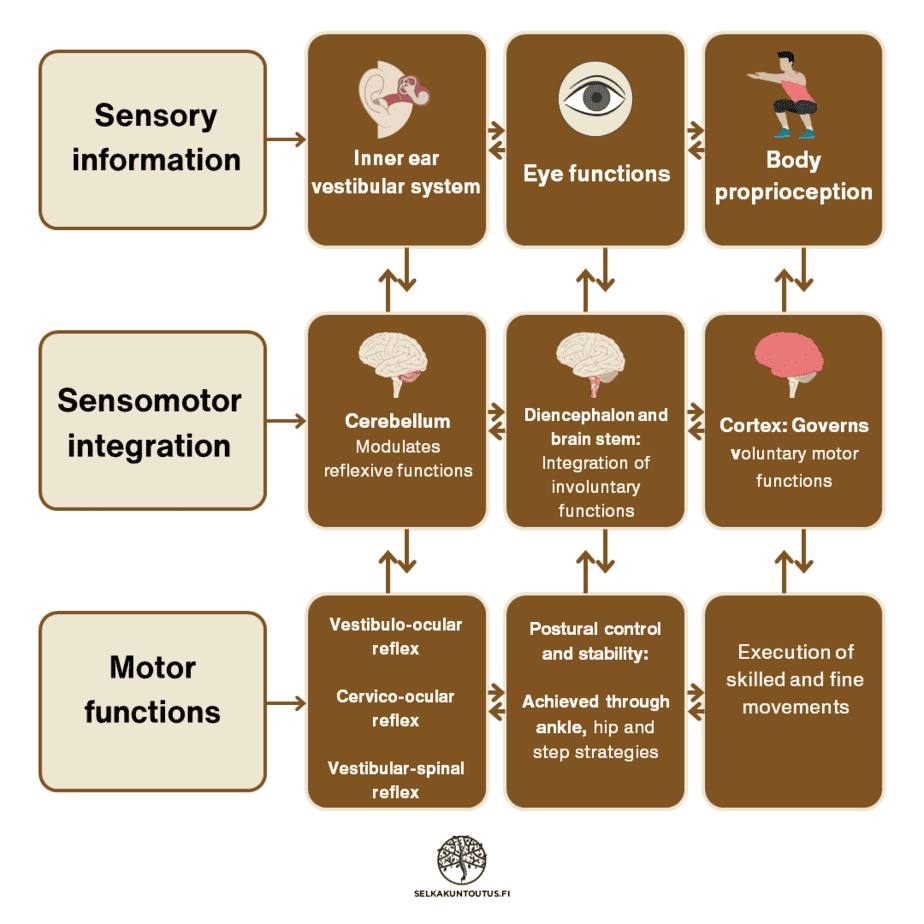
- The brain combines sensory inputs from inner ear, vision, and body to maintain stability.
- If the signals are out of sync or processed incorrectly, conflicting information arises, which we perceive as vertigo, dizziness and/or imbalance.
What causes vertigo, dizziness, and imbalance?
How Balance Normally Works
The balance system integrates information from three primary sources:
- Inner ear (vestibular system) – senses head position and motion
- Vision – provides spatial orientation
- Body (proprioception) – signals joint and muscle position
The brain combines these sensory inputs to maintain stability. If the signals are out of sync or processed incorrectly, conflicting information arises, which we perceive as dizziness or imbalance.
Symptoms related to vertigo, dizziness, and imbalance
When dizzy, you feel a sensation of imbalance or an altered perception of movement in yourself or your surroundings. It may feel sensations of:
- Rocking, swaying, or falling
- Spinning or whirling (vertigo)
- Faintness or light-headedness
- Worrying, stressing out, or frightening sensations
- Fatigue, unsteadiness, or poor coordination
Types of Dizziness
For clarity, dizziness is often divided into two broad categories:
- Rocking (non-spinning) dizziness – swaying, falling, or ship-deck sensations
- Spinning dizziness (vertigo) – a false sense of rotation
Each type has distinct causes and features, outlined below.
Common Causes of Rocking Dizziness and Imbalance
Cervicogenic dizziness
- Cause: Dysfunction of neck muscles, which normally provide key sensory input for balance.
- Symptoms: Rocking, swaying, or a ship-deck-like sensation of dizziness; typically continuous and varying in intensity.
- Associated signs: Neck and shoulder tension or pain.
Read more Cervicogenic dizziness
PPPD (Persistent Postural-Perceptual Dizziness)
- Cause: Functional disturbance in how the brain processes balance signals.
- Symptoms: Prolonged rocking dizziness, especially in upright positions. Eye movements (e.g., scrolling on a phone while standing) often trigger symptoms.
- Associated signs: More psychological symptoms (e.g., anxiety) and fewer physical findings than in cervical vertigo.
Read more PPPD (Persistent Postural-Perceptual Dizziness)
Age-Related Dizziness
- Cause: Natural, age-related changes in balance systems.
- Symptoms: Gradual increase in unsteadiness, imbalance, and instability.
- Associated signs: Difficulty with rapid head movements while walking; increased risk of falls.
Read more Age-Related Dizziness
Eye-Related Dizziness
- Cause: Disturbances in head-eye coordination and tracking movements.
- Symptoms: Variable, ongoing dizziness with eye strain and difficulty focusing.
- Associated signs: Prolonged screen use or visual tasks worsen symptoms.
Read more Eye-Related Dizziness
Visual Motion Sensitivity
- Cause: Excessive reliance on vision when inner ear or body balance signals are weakened.
- Symptoms: Imbalance, motion sickness, and fatigue triggered by visual stimuli.
- Associated signs: Busy environments (e.g., supermarkets, crowds) and moving objects provoke dizziness.
Read more Visual Motion Senstivity
Mal de Débarquement Syndrome (MdDS)
- Cause: Functional disturbance in brain regulation after passive motion (e.g., disembarking from a ship).
- Symptoms: Persistent swaying or rocking sensation, even after the journey ends.
- Associated signs: Can also occur after flights, train rides, virtual reality, or head injuries.Post–Joint Replacement Imbalance
- Cause: Hip or knee replacement surgery affecting balance.
- Symptoms: Ongoing imbalance and dizziness during recovery.
- Associated signs: Pre-existing balance problems often contribute to the development of this condition.
Common Causes of Spinning Dizziness (Vertigo)
Benign Paroxysmal Positional Vertigo (BPPV)
- Cause: Inner ear semi-circular canal dysfunction.
- Symptoms: Brief (<20 seconds) vertigo triggered by head movements (e.g., rolling in bed).
- Associated signs: Nausea and eye twitching (nystagmus).
Read more Benign Paroxysmal Positional Vertigo (BPPV)
Vestibular Migraine
- Cause: Migraine-related dysfunction of the balance system.
- Symptoms: Episodic vertigo, with or without headache.
- Associated signs: Typical migraine features (sensitivity to light and sound, aura).
Read more Vestibular Migraine
Ménière’s Disease
- Cause: Dysfunction of the inner ear, often linked to fluid imbalance.
- Symptoms: Episodic vertigo with hearing loss.
- Associated signs: Tinnitus, ear fullness, increased risk of falls.
Read more Ménière’s Disease
Ear-Related Vertigo
- Cause: Disorders of the inner ear or vestibular nerve.
- Symptoms: Constant or episodic vertigo.
- Associated signs: Hearing changes, imbalance, nausea.
Read more Ear-Related Vertigo
Common Causes of Mixed Rocking or Spinning Dizziness
Multifactorial Dizziness
- Cause: Multiple balance system disturbances at once.
- Symptoms: Prolonged, variable dizziness combining different features.
Central (Cerebral) Vertigo
- Cause: Disturbances in the brain (such as the cortex, brainstem, cerebellum, or thalamus).
- Symptoms: Variable depending on the underlying disease.
- Common causes: Stroke, multiple sclerosis, infections, vestibular migraine.
Psychological Dizziness
- Cause: Anxiety, stress, or depression affecting balance perception.
- Symptoms: Dizziness linked to psychological strain.
- Associated signs: Sleep problems, fatigue, difficulty relaxing.
Read more Psychological Dizziness
Concussion (Post-Concussion Syndrome)
- Cause: A mild traumatic brain injury.
- Symptoms: Headaches, blurred vision, rocking dizziness; vertigo possible.
- Associated signs: Anxiety, depression, sleep problems, fatigue.
Read more Concussion (Post-Concussion Syndrome)
Whiplash Injury
- Cause: Trauma to neck from falls or collisions.
- Symptoms: Neck and shoulder pain, headaches, and disturbances in balance.
- Associated signs: Fatigue, anxiety, sleep difficulties.
Read more Whiplash